Validating Holistic Student Preparation in a €1.7B Market
Client
NDA - Major Spanish educational publisher
role
Lead Product Designer & Builder
timeline
10 weeks | 2025
team
1 PM, 1 Business Designer, 1 Growth Manager
The opportunity
Be the first to integrate study planning with wellbeing support as a differentiated offering.
Approach
We converted research insights into Jobs To Be Done, prioritizing five core jobs: planning, comprehension, practice, exam preparation, and emotional management (our differentiation). This framework ensured every design decision connected to validated needs.
We defined 8 critical hypotheses that could invalidate the business, then used story mapping to design the minimal experience to test them. Using Lovable (a low-code platform), I built a fully functional web app in 5 weeks, allowing us to invest the remaining time in structured validation with 27 students over 4 weeks.
Designing for emotional intelligence
The core design challenge: would students engage with wellbeing features, or dismiss them as distractions?
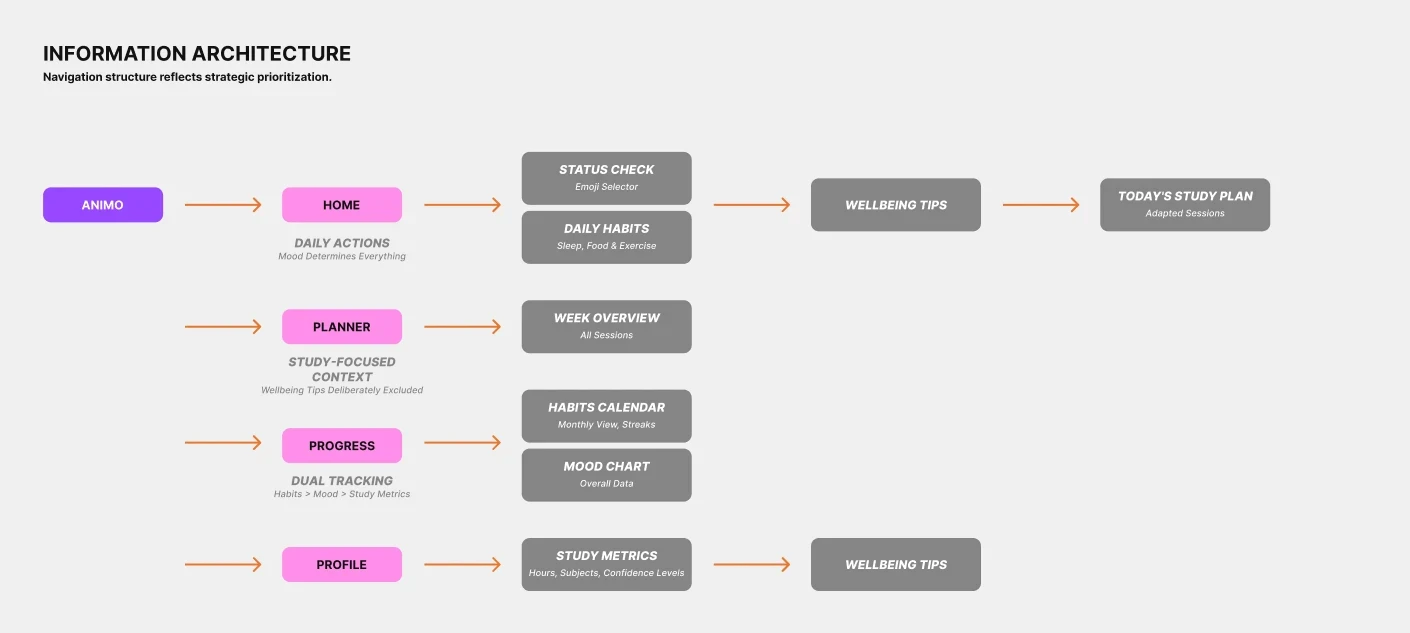
Information architecture: wellbeing first
I made a risky choice: mood check-in as the most prominent home screen element, more prominent than the study plan itself. Students open study apps to see tasks, but our research showed forcing sessions during low emotional states backfires.
The home hierarchy: Mood check-in → Daily habits → Study plan (adapted based on mood). This visual prioritization manifested our value prop: wellbeing determines your plan, not vice versa.
Navigation used familiar bottom tabs prioritizing usability over novelty: Home (daily actions), Agenda (weekly overview), Progress (dual tracking), Profile (settings).
Mood check-in: iteration to simplicity
I tested three patterns for daily mood input:
Text input: High friction, not appealing
Slider: Users "played" with it, felt game-like
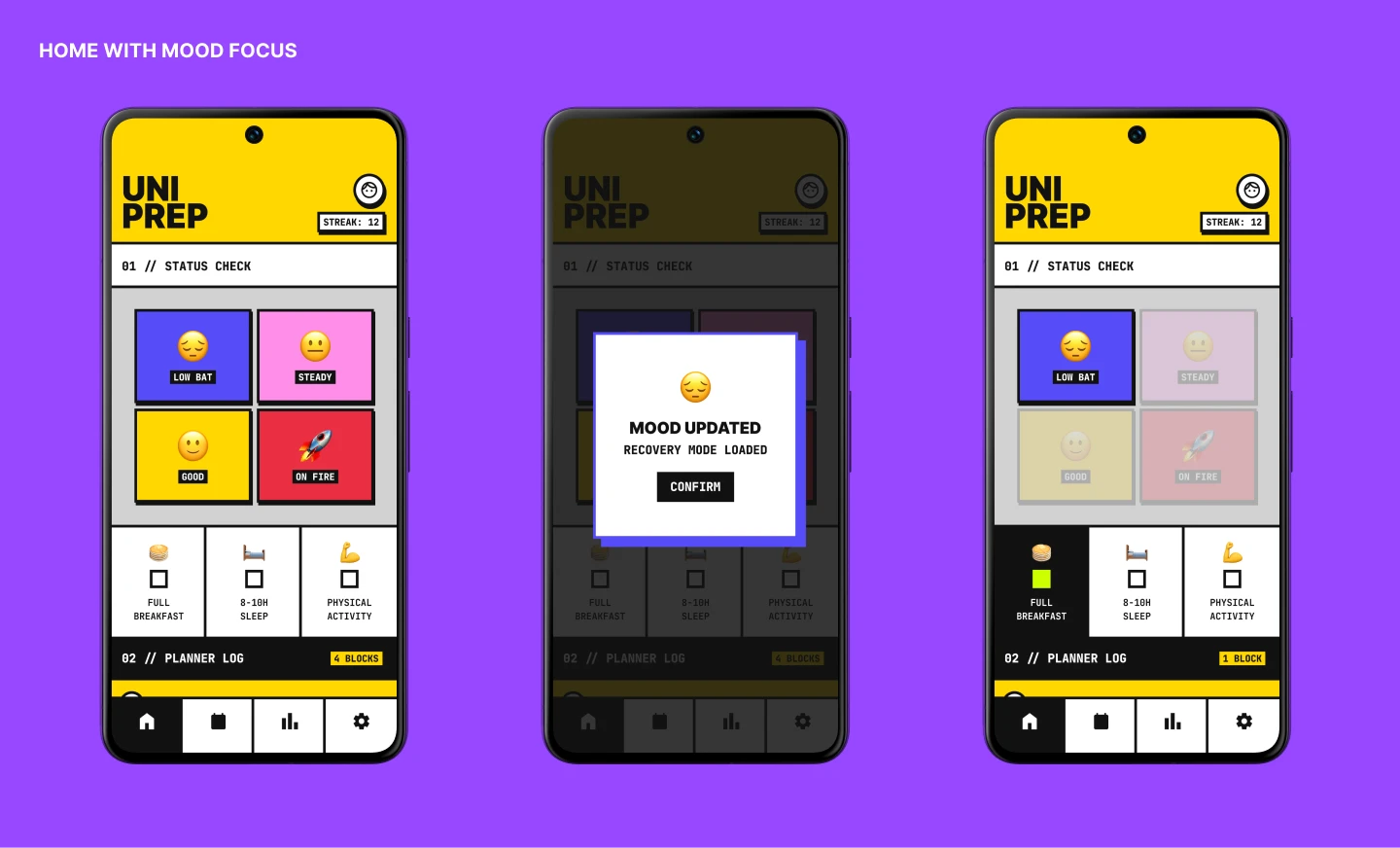
Emoji selector: Visually immediate, single-tap speed
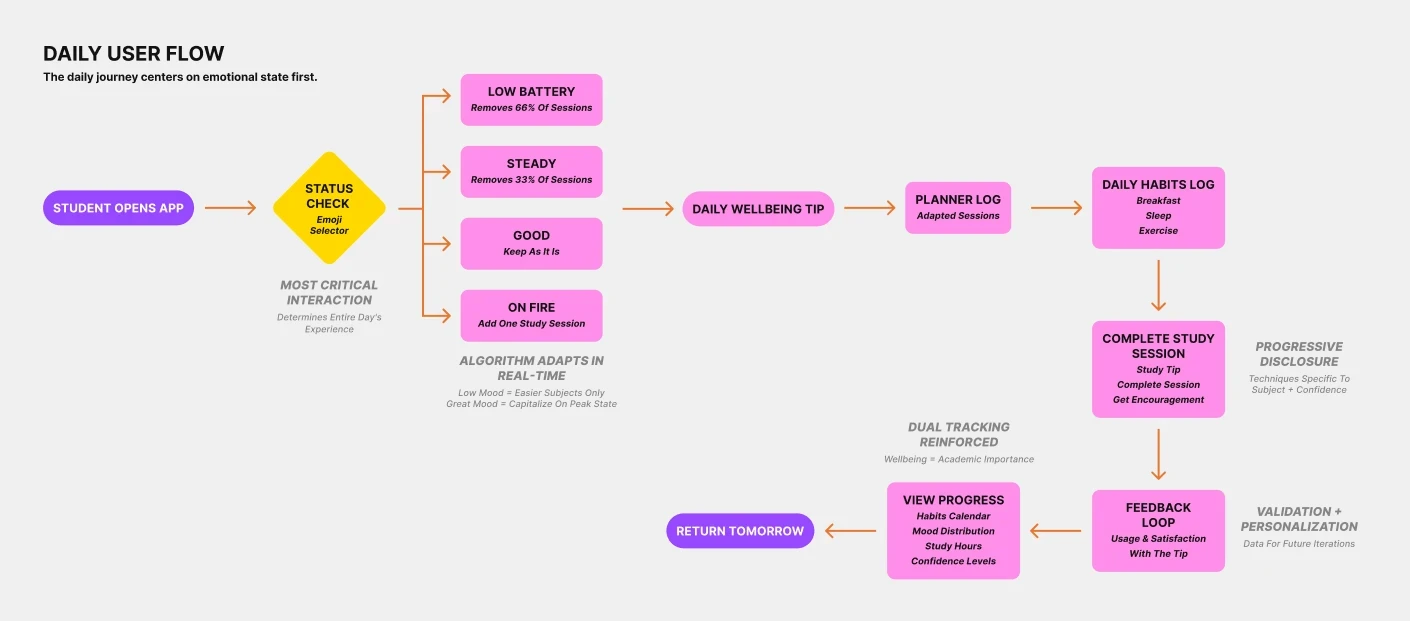
The emoji selector won, striking a balance between speed and meaningfulness. The app responded immediately: low mood removed 66% of sessions (keeping easier subjects), great mood added an extra session. Each response included encouraging messages: "Cozy Vibes: Self-care is a total game-changer for your mental health..."
This wasn't data collection; it was emotional design responding supportively, not algorithmically.
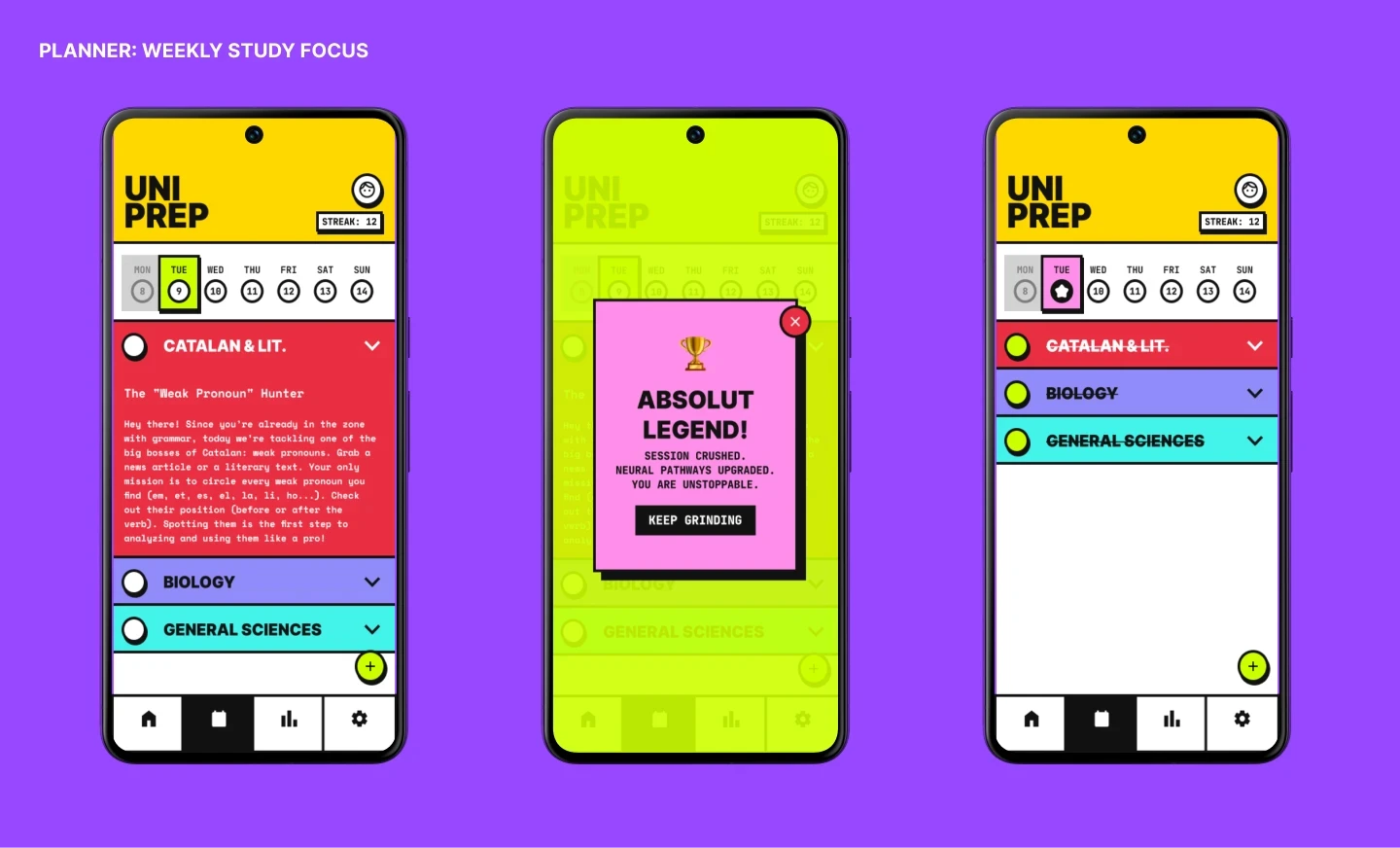
Study sessions: progressive disclosure
Sessions appear as cards with three states:
Closed: Subject + duration (glanceable)
Open: Study technique specific to subject/confidence (actionable)
Complete: Radio button → encouraging pop-up ("Boom! Check that one off. Let's get ready for the next one!")
Completing all daily sessions triggered a special message (reward pattern for habit formation). After each session, I asked: "Did you use this tip? Like it?" creating a validation feedback loop.
Progress: reinforcing connection
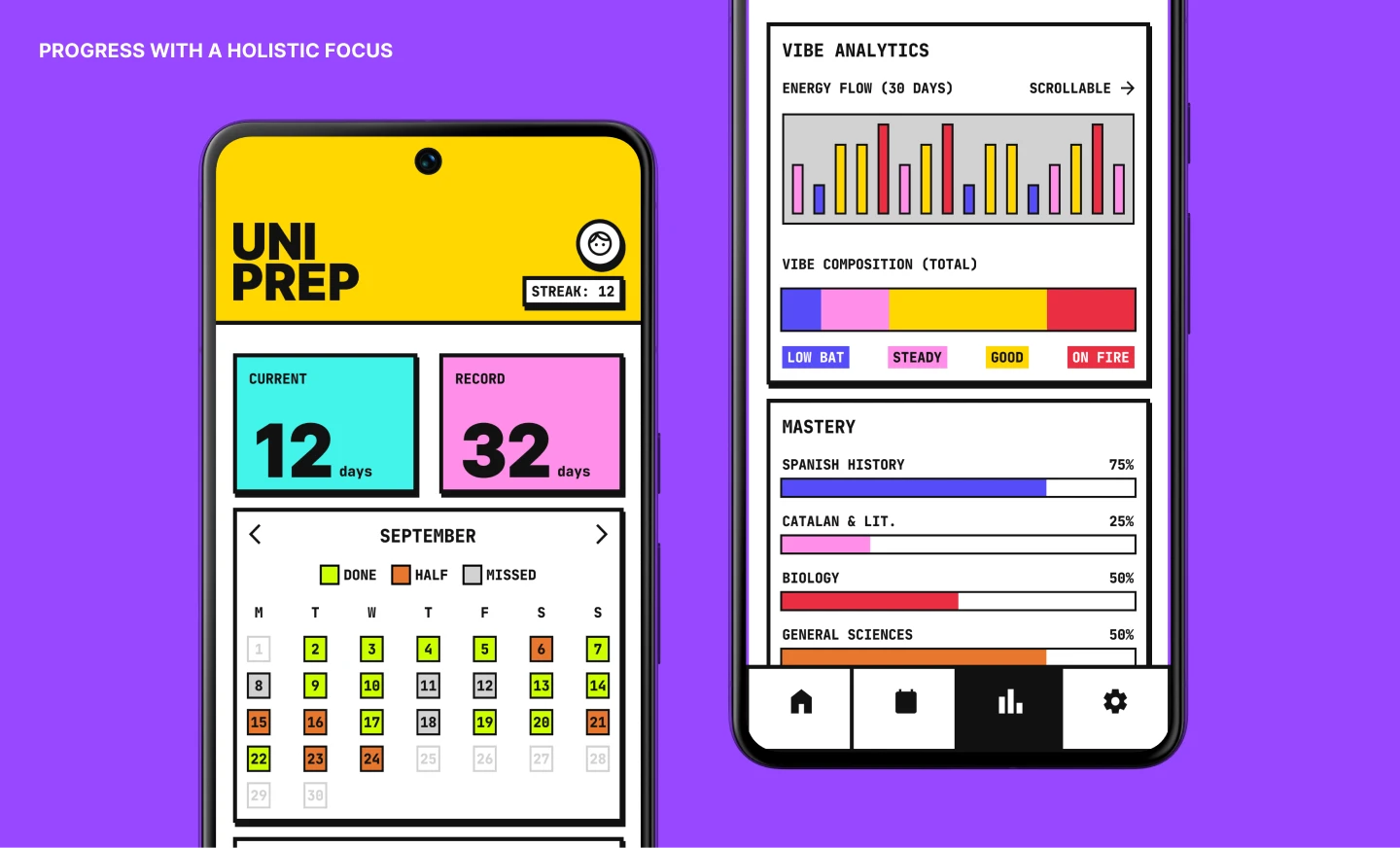
Visual hierarchy proved our value prop:
Daily habits calendar (month view, most prominent) for streak-building
Mood tracker (half-pie chart showing distribution, not daily guilt)
Study metrics (hours, confidence bars)
I chose the half-pie chart over a timeline so that students could see their overall state, rather than being fixated on bad days. Language was always reassuring: no red "missed" indicators, no urgency, no shaming.
Visual design: bold minimalism
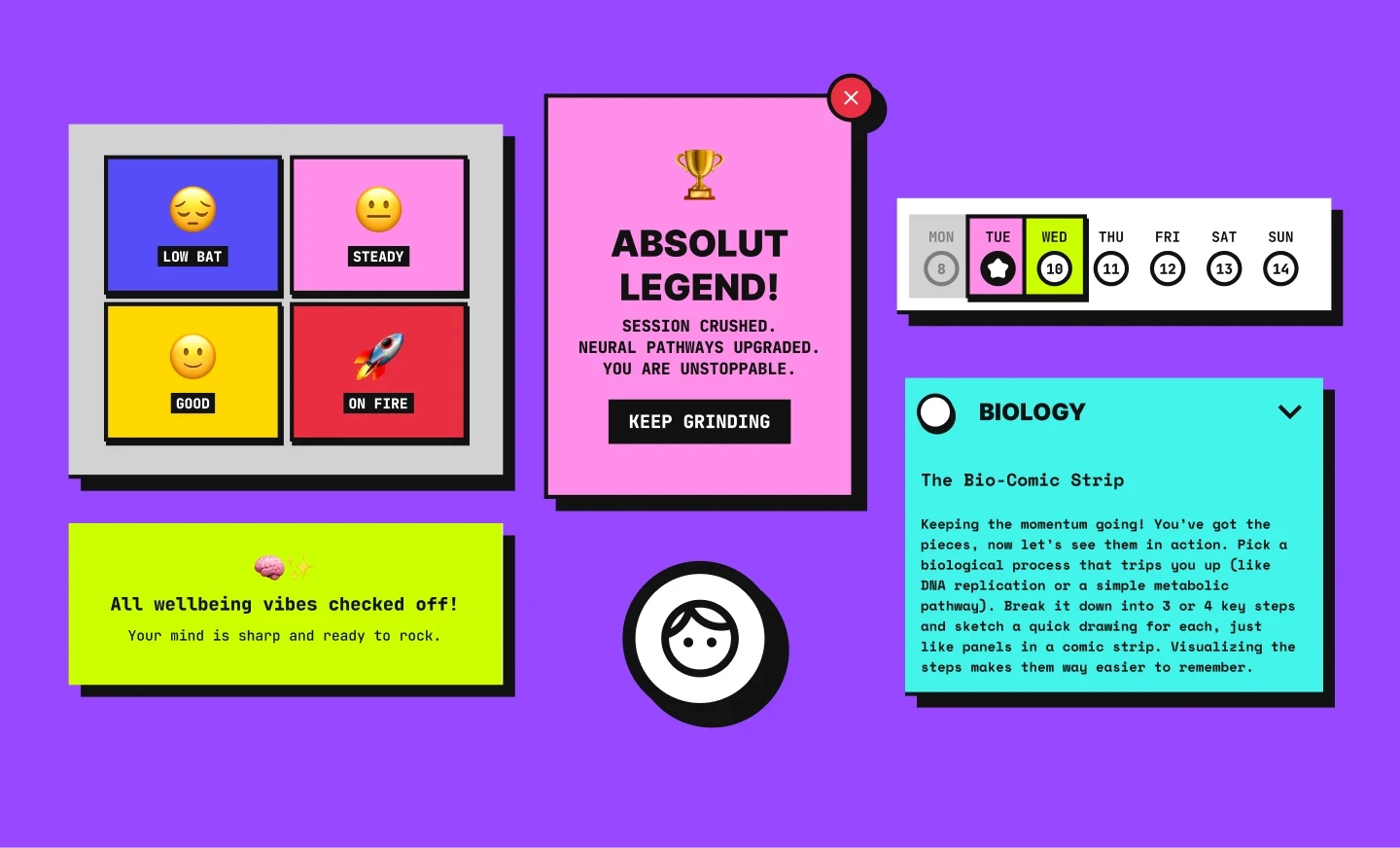
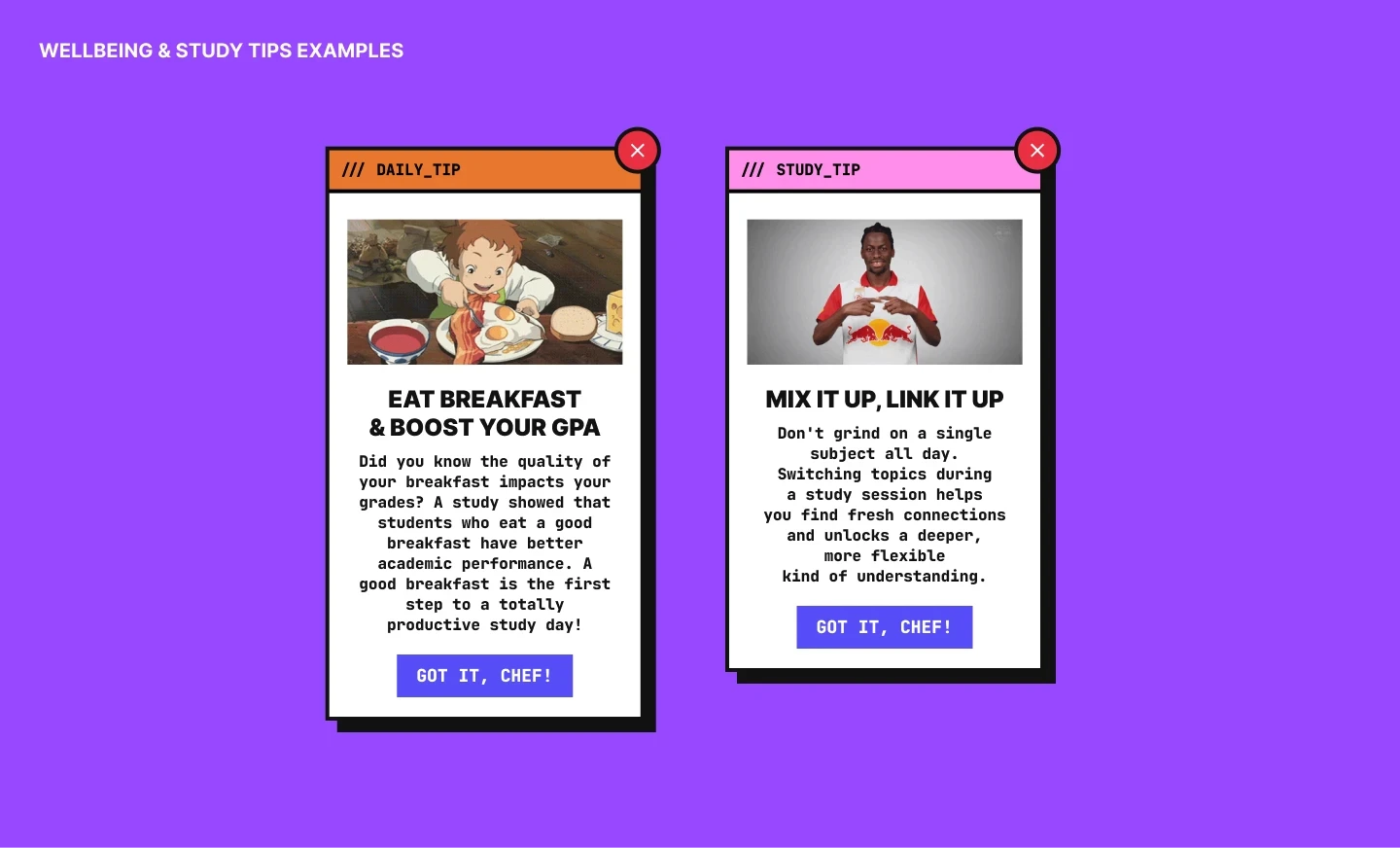
Given Lovable's constraints and 5-week timeline, I chose bold colors, large typography, high contrast, energetic and youthful, not clinical. I used GIFs and emoji (instead of custom illustrations) to keep the tone light while focusing design effort on interaction patterns.
The copy spoke like teenagers: "Hey, Legend! To keep crushing it like that..."
Design tradeoff's
I made conscious tradeoffs, prioritizing validation over polish:
✅ Established patterns (bottom nav, cards) for familiarity
✅ Minimal visual design to accelerate build
✅ GIFs/emoji over custom illustrations
❌ Deep customization (time-prohibitive)
❌ Drill-down interactions (MVP scope)
During testing, the #1 request was planner flexibility. I quickly iterated: confidence adjustment became available anytime (originally weekly), addressing the friction that students' feelings changed daily.
Results & validation
Product-market fit:
7.35 NPS, 70% rated recommendation 7+/10
60% continued using after test ended (unprompted)
62% dual-use rate (study + wellbeing together)
Mood-adaptive planning ranked #1 feature
Impact:
+38% improvement in organization
+44% felt emotionally better
€5.69/month willingness to pay
Schools validated B2B2C interest
Key insights
1. Early adopters weren't the most chaotic students, but those with moderate organization (65% "sometimes organized but improvise") who had high anxiety but enough stability to adopt a new habit.
2. Wellbeing integration validated as differentiator: Students rated it 8/10 in importance. On active days, 62% used both features, proving the connection wasn't theoretical. Generic AI can tutor; ANIMO treats emotional state as a planning input.
3. Intelligence must mean flexibility: The #1 improvement request was personalization, manual adjustments, exam tracking, and grade-based rebalancing. Students wanted optimization, but needed override control.
4. Notifications drove 25% more engagement: Activity jumped from 48% to 60% when activated, proving habit formation requires active triggers.