Working with a major European insurance company, I led the design of a transformative AI-powered claims system. Over 4 weeks, our team designed two pilot workflows: a 2027 automated simple claims experience and a 2030 modular AI orchestration for complex cases, creating the strategic foundation that secured executive approval and budget for development.
Client
NDA - Major European Insurance Company
role
Lead Product Designer
timeline
4 weeks | 2025
team
1 PM, 1 Business Designer, 2 Product Designers
The problem
Claims processing is trapped between customer expectations and operational reality.
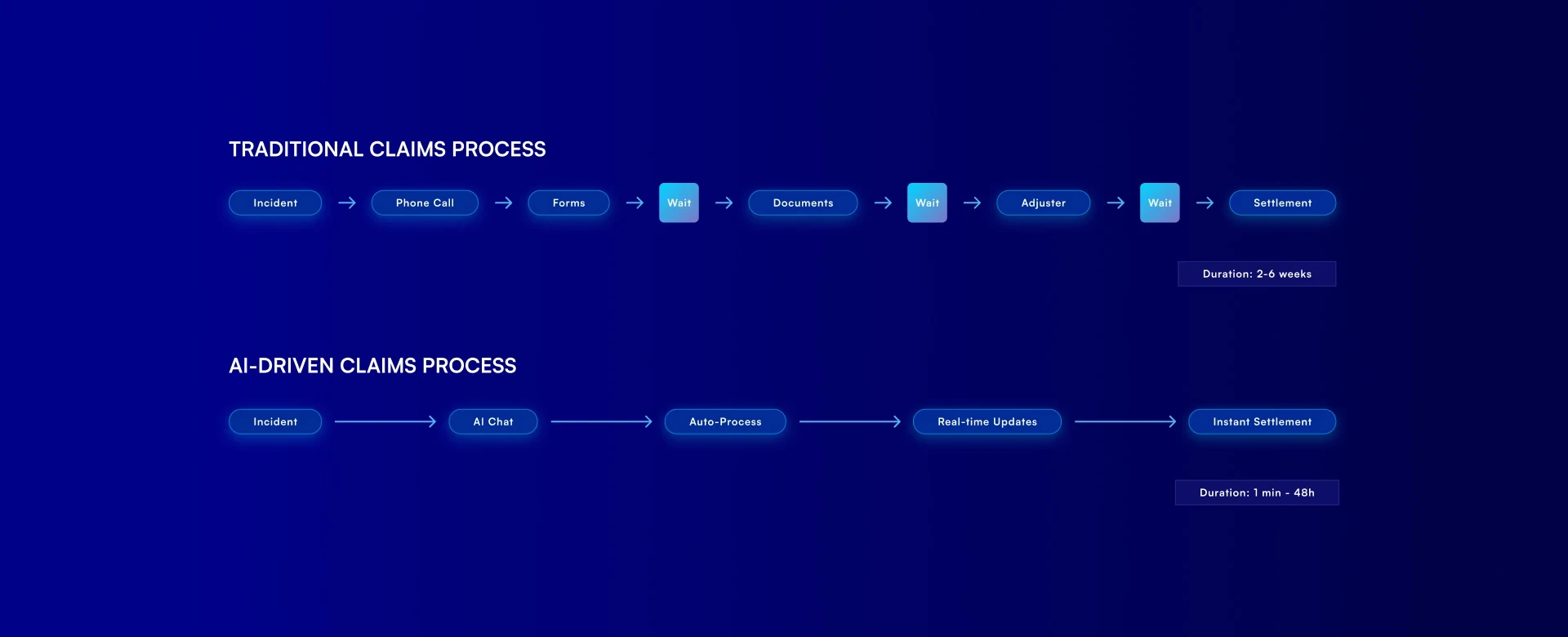
Modern customers expect Amazon-level service, but insurance claims still require manual document processing, phone calls, and weeks of silence. Through discovery sessions and exploratory research, we identified a critical gap: customers could track a $15 pizza delivery in real-time but waited weeks with zero visibility on thousand-dollar claims.
Current state pain points
Customer Experience: Manual FNOL (First Notice of Loss) submission, zero status updates, multi-week wait times for simple claims
Internal Operations: Significant manual processing, adjusters are buried in administrative work, and fragmented workflows across legacy systems
Business Impact: Declining customer satisfaction, rising operational costs, and competitive disadvantage
My role & approach
As Lead Product Designer, I directed the end-to-end design process:
Strategic Foundation
Facilitated discovery sessions and expert interviews with claims leadership
Conducted exploratory research on AI trends and competitive landscape
Co-led vulnerability analysis evaluating competitive exposure to AI disruption
Design Leadership
Led design team (2 Product Designers) through future scenario development
Designed two future-state pilot blueprints: 2027 simple claims automation and 2030 complex claims orchestration
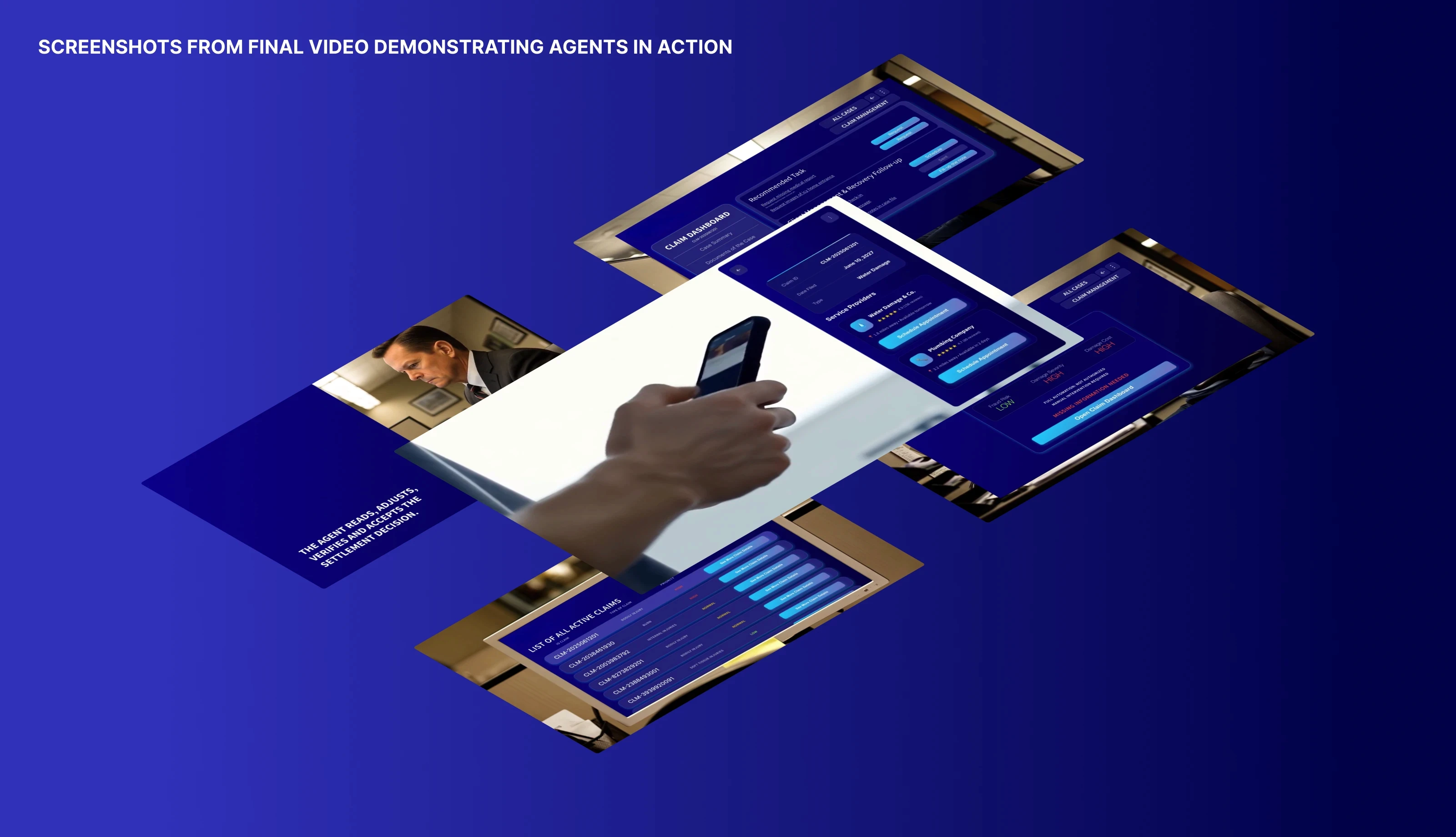
Created executive storyboards and video simulations demonstrating the AI transformation vision
Research & discovery
We designed a sprint-based research structure to generate high-confidence insights quickly:
Week 1-2: Understanding Current State
Discovery sessions with claims management teams
Exploratory research on industry trends, competitors, and emerging AI capabilities
Week 2-3: Validating AI Opportunities
Expert interviews with internal and external AI specialists
Vulnerability analysis evaluating business against AI disruption
Week 3-4: Defining Future Scenarios
Future scenario workshop mapping claims evolution (2025-2030)
Consolidation of most plausible scenarios
Key Research Insights
Adjusters spend most of their time on administrative tasks (document chasing, data entry, status updates) instead of the complex judgment work only they can do
Digital-native insurers processing simple claims in under 24 hours
AI can handle significant document processing, but human expertise is critical for complex decisions
Market expectation shifting toward immediate resolution for simple claims
Design Strategy
Progressive Automation: 2027 to 2030
2027 Pilot: Automated Simple Claims
Target: Routine property damage with clear liability
Goal: Under 60 second resolution from submission to settlement
Approach: AI handles entire workflow, humans monitor for exceptions
2030 Vision: AI Orchestration for Complex Claims
Target: Multi-party liability, injury claims, catastrophic events
Goal: AI coordinates all routine tasks, humans focus on decisions
Approach: Modular agents handling specific tasks, human oversight on strategy
Key design decisions
Decision #1: Two-Phase Pilot Approach
Designing distinct 2027 (simple) and 2030 (complex) workflows allowed us to prove value incrementally rather than attempting risky full transformation immediately.
Decision #2: Conversational FNOL Instead of Forms
Natural language AI can extract structured data from conversation, reducing customer friction from multiple form fields to natural dialogue while improving data quality.
Decision #3: Real-Time Visual Damage Assessment
Visual AI analyzing photos instantly transforms multi-day assessment waits into 60-second processes for simple property damage.
Decision #4: Proactive Status Updates
Showing real-time claim progress eliminates repetitive status inquiry calls, improving customer satisfaction while freeing staff for complex cases.
The solution
Two pilot workflows: phased AI transformation
I designed strategic blueprints mapping future-state experiences, system architecture, and service touchpoints, creating the foundation for technical development.
Pilot 1: 2027 Automated Simple Claims
1. Instant FNOL via Mobile
Conversational interface extracts claim details from natural language
No forms, minimal friction
2. Visual Damage Assessment
AI-guided photo capture with computer vision analysis
Instant repair estimate with fraud detection
3. Automated Settlement
System validates coverage and auto-approves claims meeting thresholds
Instant notification with payment timeline
Total Time: Under 60 seconds from submission to approval
What I Created
Service Blueprint: Customer journey across all touchpoints, AI agent responsibilities, human oversight triggers, system integration requirements
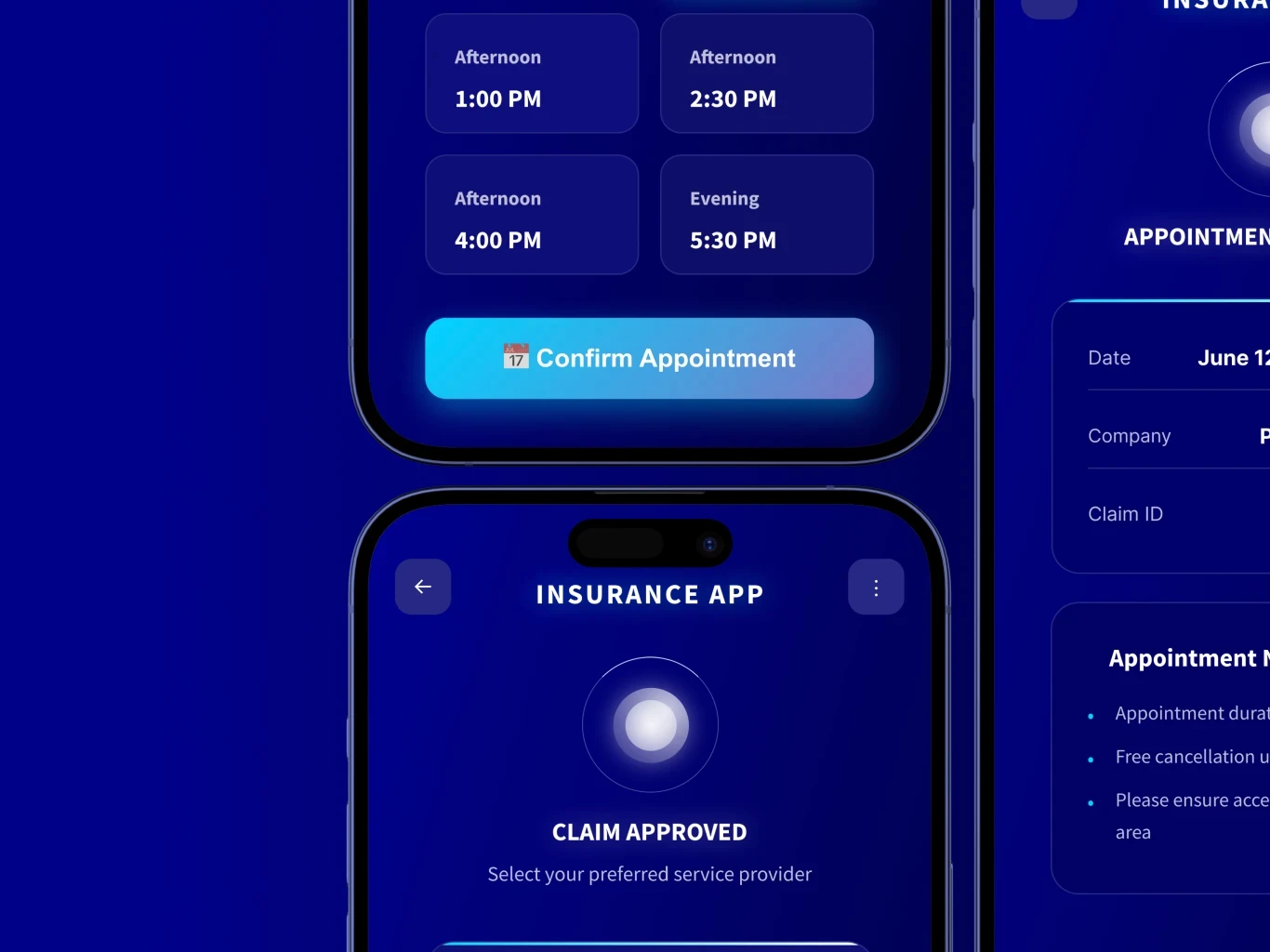
Experience Concepts: Wireframes showing potential conversation flow, photo guidance, status transparency, approval patterns, adjuster monitoring dashboard
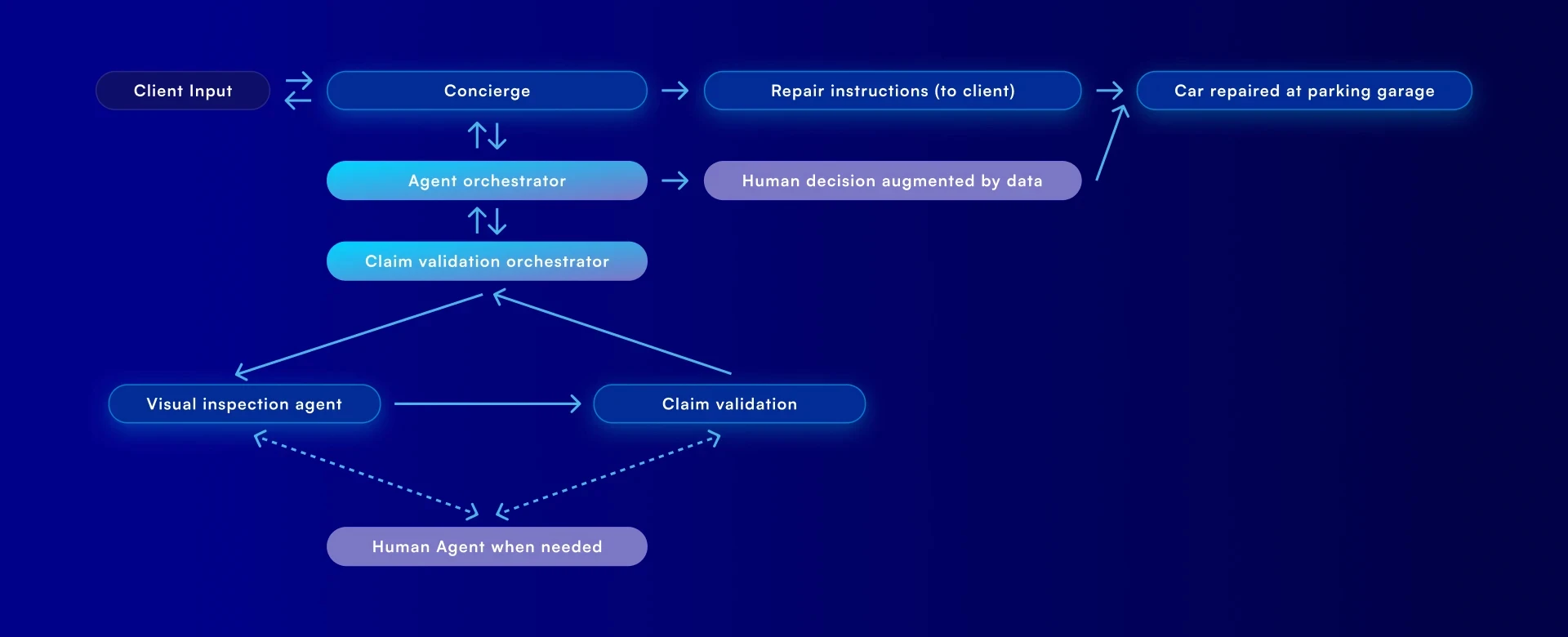
System Architecture: AI agent orchestration logic, data flows, integration points, exception handling processes
Key Innovation: Defined how AI could handle entire simple claims workflow while maintaining human oversight for edge cases.

Pilot 2: 2030 Complex Claims Orchestration Blueprint
1. Intelligent Triage
AI analyzes complexity and triggers senior adjuster assignment
Human oversight was established immediately
2. Automated Evidence Assembly
AI orchestrates photo collection, police reports, and medical communications
Delivers a comprehensive case package to the adjuster in hours vs. days
3. AI-Assisted Decision Support
System suggests liability analysis, flags conflicts, and surfaces precedents
Adjuster makes final determination with AI insights
4. Ongoing Orchestration
AI manages routine communications and tracking
An adjuster focuses on negotiation, empathy, and strategic decisions
What I Created
Service Blueprint: End-to-end orchestration across all parties, AI coordination logic, human decision points, workflow from triage to settlement
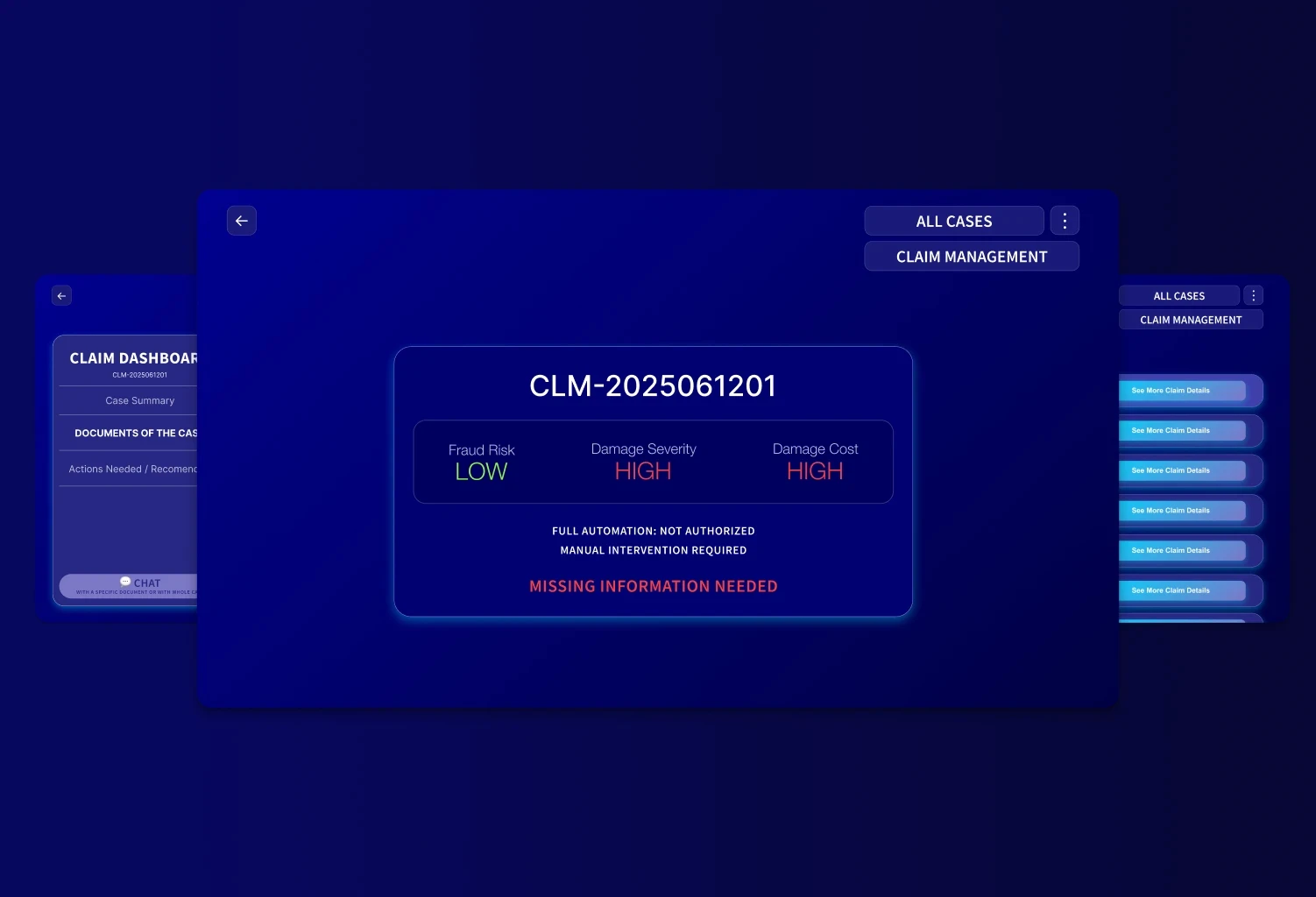
Experience Concepts: Adjuster dashboard wireframes, communication hub, evidence assembly interfaces, decision support visualizations, timeline showing AI-handled vs. human-decided activities
System Architecture: Multi-agent orchestration model, human-AI collaboration patterns, escalation mechanisms, quality assurance checkpoints
Key Innovation: Defined how AI agents coordinate complex workflows while preserving human expertise for judgment and strategy

System architecture overview
Five core AI agent concepts:
Claims Concierge: Customer conversation, data extraction, routing
Visual Assessment: Photo analysis, damage estimation, fraud detection
Triage: Complexity classification, routing, priority assignment
Orchestration: Multi-party coordination, evidence assembly
Settlement: Coverage validation, payment processing
Human Oversight: Exception monitoring, quality assurance, escalation triggers, strategic decision checkpoints
Results & key learnings
Project outcome
The strategic vision I designed, executive storyboard, service blueprints, and video simulations, was presented to executive leadership in 2025 and secured budget approval for development.
Strategic principles
Blueprint work drives strategic alignment
Designing future-state systems without final UI forced us to focus on fundamental experience logic and architecture rather than pixel-perfect execution. This strategic approach (combined with video simulations that made the vision tangible) proved more valuable for executive decision-making than polished mockups would have been.
Modular thinking enables buy-in
Designing composable AI agents (vs a monolithic system) allowed stakeholders to envision a gradual rollout. "We can start with just a visual assessment," made the investment feel manageable and reduced perceived risk.
AI as partner, not replacement
Framing AI as intelligent support, not replacement, drove stakeholder embrace. When adjusters understood AI would handle the administrative burden so they could focus on complex decisions, the vision shifted from threatening to empowering.
What I'd Do Differently
Opportunities for Scale
This engagement was scoped as a strategic blueprint: the right format for securing executive alignment before committing to full development. As the project moves into implementation, there are clear opportunities to deepen the work:
Adjuster co-design sessions to validate AI-assistance patterns against real workflow constraints before build.
Interactive prototypes for key decision-support flows, enabling stakeholders to stress-test edge cases dynamically rather than through static scenarios.
Edge case documentation for fraud, disputes, and system failures, a natural phase 2 once technical teams validate primary scenario architecture.
Key Takeaway
Strategic design work isn't about polished pixels; it's about creating compelling visions that align stakeholders around a transformative future while defining the architecture to get there.
Success resulted from making a complex AI future feel real and reachable through clear plans, engaging storytelling, and modular thinking that let stakeholders picture the path from the current state to the future.